December 17-31, 1825
Here are the posted journal entries for December 17-31, 1825.
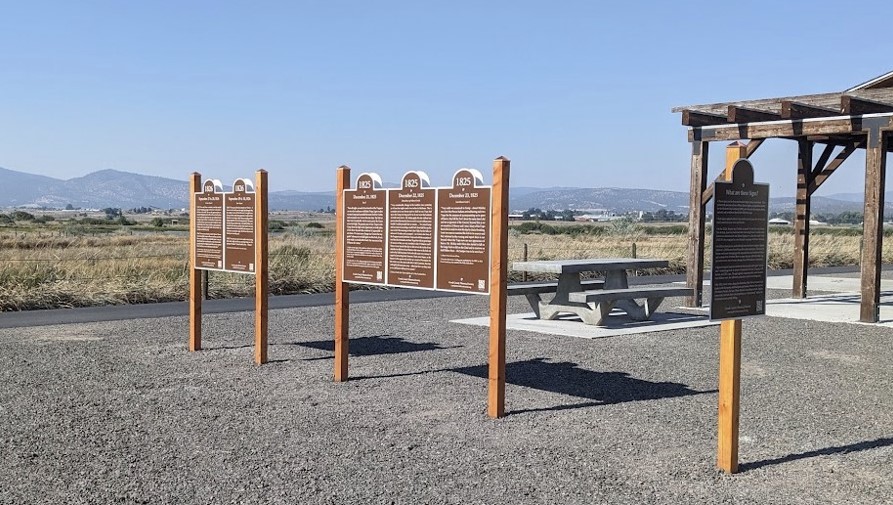
December 17, 1825
near Crooked River wetland complex1
“We started early all our horses safe this day, our course on starting S.E. by S for 4 miles across a high Mountain2 well stocked in wood of the Fir Tree when we descended into a large Plain covered with wormwood3, crossed over the Plain due South and fell on another Fork4 of the River of the Falls which we left on the 14th ins. and encamped, nearly 100 Traps sett with hopes of success. In crossing the Mountain this day, we saw about 40 huts of Indians I presume not more than 10 days since they were abandon’d, as these huts resemble in form and shape those I saw last Fall in the lower part of the Snake Country I conclude it must be Snake Indians and of course we will soon see them. I am in hopes the River will give us a few Beaver, it look well running through a fine Plain and well lin’d with Willows and deep, the soil on its banks also good – but not more than 200 yards below nothing to be seen but Sand. 3 Deer killed this day and tracks of 2 Red Deer5 seen, distance this day 8 miles. Weather fine & mild.”
1. Main camp ~ 3 miles downstream of wetland complex.
2. Grizzly Mountain.
3. Sagebrush.
4. Crooked River.
5. Elk.
December 18, 1825
near Crooked River wetland complex
“Had the remainder of our Traps sett as I intend to give this River a chance and at the same time recruit2 our Horses ere3 we attempt proceeding farther. Being now I presume on the borders of the Snake Lands we require to watch our Horses day and night. We must regulate our march accordingly in case the winter should be severe, so far we have no cause to Complain as the Weather is still very Mild. God grant it may remain so. 14 Beavers this day.”
1. From a base camp a few miles west, trappers spread out through the wetland complex and its tributary streams.
2. Rest.
3. Before.
December 19, 1825
near Crooked River wetland complex
“Cloudy with shower of rain during the night, but fine and Clear to Day. Fine weather for hunting Beaver. We did not raise Camp, all appear to be very industrious to procure Beaver and we this day took 38.”
December 20, 1825
near Crooked River wetland complex
“Really warm weather. As one third of our Traps are in the rear of our Camp, I did not raise Camp so as to give all an equal and fair chance. If this River had not been visited by the Fort Nez Percee Indians it would have yielded from 4 to 500 Beavers1 – our success this day 21 Beavers. Many of the trappers having obtained permission to Sleep out of the Camp have not in consequence come in. One of the Trappers also caught in his Trap a Raccon nearly the size of an Indian Dog, indeed the largest I have yet seen. I presume this fellow was in quest of Beaver, it may be truly said Beaver is a prey of Man and Beast.”
1. Ogden notes that the “Fort Nez Percee Indians” had trapped the wetland complex before him and taken 400–500 beaver, yet his party still took nearly 100 (38 + 21 + 39 = 98) during three days there. The combined harvest illustrates the remarkable abundance of beaver that once occupied the area.
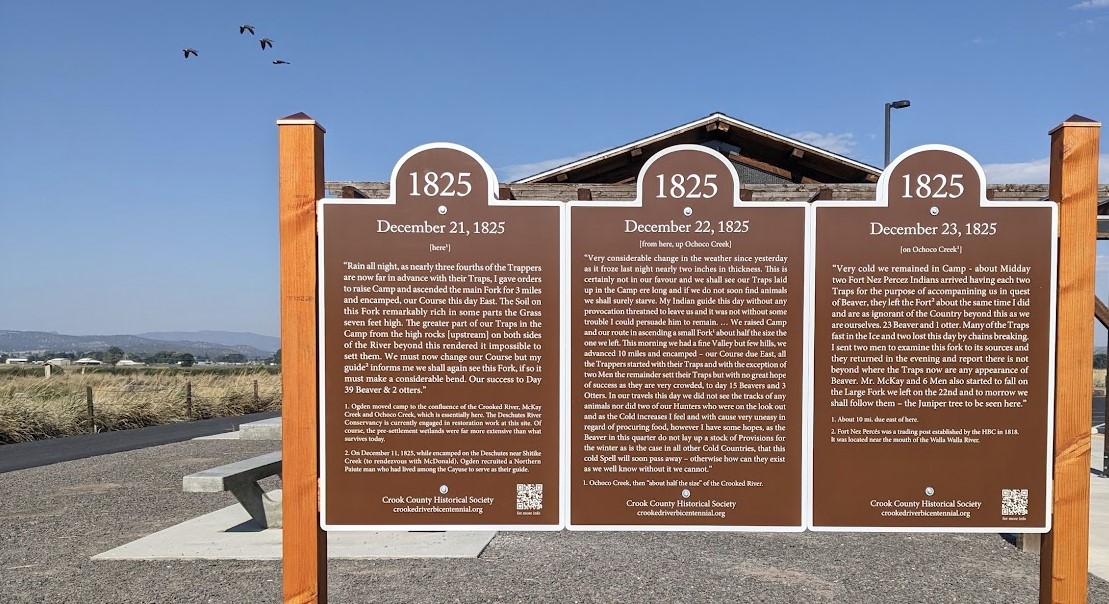
December 21, 1825
at Crooked River wetland complex1
“Rain all night, as nearly three fourths of the Trappers are now far in advance with their Traps, I gave orders to raise Camp and ascended the main Fork for 3 miles and encamped, our Course this day East. The Soil on this Fork remarkably rich in some parts the Grass seven feet high. The greater part of our Traps in the Camp from the high rocks [upstream] on both sides of the River beyond this rendered it impossible to sett them. We must now change our Course but my guide2 informs me we shall again see this Fork, if so it must make a considerable bend. Our success to Day 39 Beaver & 2 otters.”
1. Ogden moved camp to the confluence of the Crooked River, McKay Creek and Ochoco Creek. The Deschutes River Conservancy is currently engaged in restoration work at this site. Of course, the pre-settlement wetlands were far more extensive than what survives today.
2. On December 11, 1825, while encamped on the Deschutes near the Warm Springs River (to rendezvous with McDonald), Ogden recruited a Northern Paiute man who had lived among the Cayuse to serve as their guide.
December 22, 1825
up Ochoco Creek
“Very considerable change in the weather since yesterday as it froze last night nearly two inches in thickness. This is certainly not in our favour and we shall see our Traps laid up in the Camp ere long and if we do not soon find animals we shall surely starve. My Indian guide this day without any provocation threatned to leave us and it was not without some trouble I could persuade him to remain. … We raised Camp and our route in ascending a small Fork1 about half the size the one we left. This morning we had a fine Valley but few hills, we advanced 10 miles and encamped – our Course due East, all the Trappers started with their Traps and with the exception of two Men the remainder sett their Traps but with no great hope of success as they are very crowded, to day 15 Beavers and 3 Otters. In our travels this day we did not see the tracks of any animals nor did two of our Hunters who were on the look out and as the Cold increases I feel and with cause very uneasy in regard of procuring food, however I have some hopes, as the Beaver in this quarter do not lay up a stock of Provisions for the winter as is the case in all other Cold Countries, that this cold Spell will soon pass away – otherwise how can they exist as we well know without it we cannot.”
1. Ochoco Creek, then “about half the size” of the Crooked River.
December 23, 1825
on Ochoco Creek1
“Very cold we remained in Camp – about Midday two Fort Nez Percez Indians arrived having each two Traps for the purpose of accompanining us in quest of Beaver, they left the Fort2 about the same time I did and are as ignorant of the Country beyond this as we are ourselves. 23 Beaver and 1 otter. Many of the Traps fast in the Ice and two lost this day by chains breaking. I sent two men to examine this fork to its sources and they returned in the evening and report there is not beyond where the Traps now are any appearance of Beaver. Mr. McKay and 6 Men also started to fall on the Large Fork we left on the 22nd and to morrow we shall follow them – the Juniper tree to be seen here.”
1. About 10 mi. due east of Wetland Complex.
2. Fort Nez Percés was a trading post established by the HBC in 1818. It was located near the mouth of the Walla Walla River.
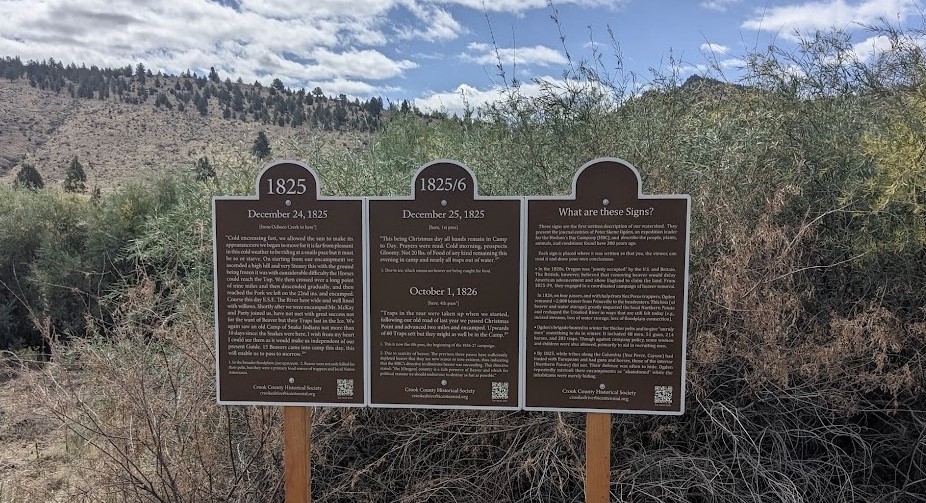
December 24, 1825
at Long Hollow1
Cold encreasing fast, we allowed the sun to make its appearance ere we began to move for it is far from pleasant in this cold weather to be riding at a snails pace but it must be so or starve. On starting from our encampment we ascended a high hill and very Stoney this with the ground being frozen it was with considerable difficulty the Horses could reach the Top. We then crossed over a long point of nine miles and then descended gradually, and then reached the Fork we left on the 22nd ins. and encamped. Course this day E.S.E. The River here wide and well lined with willows. Shortly after we were encamped Mr. McKay and Party joined us, have not met with great success not for the want of Beaver but their Traps fast in the Ice. We again saw an old Camp of Snake Indians not more than 10 days since: the Snakes were here, I wish from my heart I could see them as it would make us independent of our present Guide. 15 Beavers came into camp this day, this will enable us to pass to morrow.2”
1. Long Hollow is area at east gate of Prineville Reservoir State Park.
2. Beaver were not only killed for their pelts, but they were a primary food source of trappers and local Native Americans..
December 25, 1825
at Long Hollow
“This being Christmas day all hands remain in Camp to Day. Prayers were read. Cold morning, prospects Gloomy. Not 20 lbs. of Food of any kind remaining this evening in camp and nearly all traps out of water.1”
1. Due to ice, which means no beaver are being caught for food.
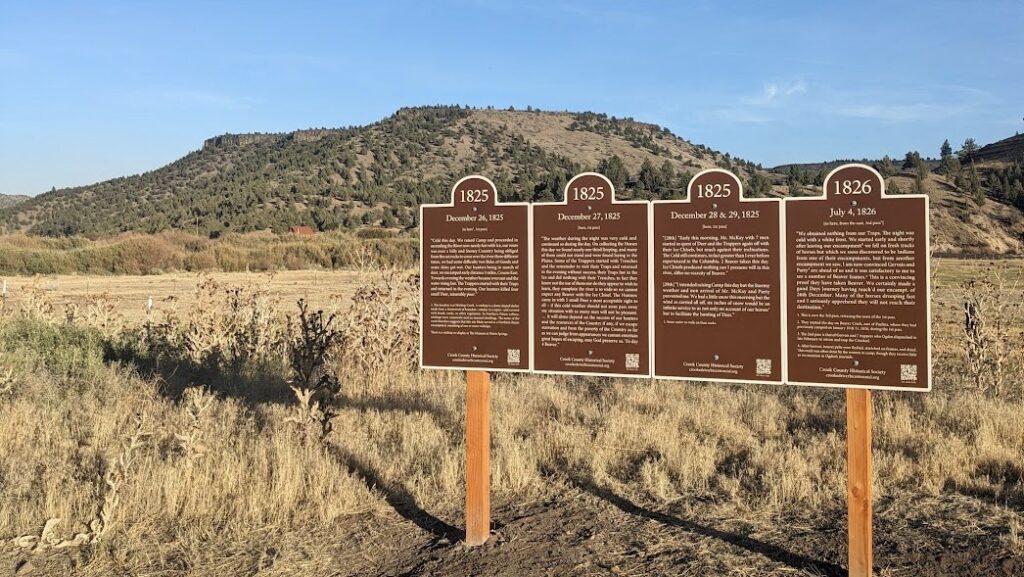
December 26, 1825
to Wickiup Creek1
““Cold this day. We raised Camp and proceeded in ascending the River now nearly fast with Ice, our route was over a hilly and Stoney Country being obliged from the cut rocks to cross over the river three different times, we had some difficulty two Bales of Goods and some skins got wet. Our hunters being in search of deer, we encamped early distance 5 miles, Course East. Towards evening the weather became overcast and the water rising fast. The Trappers started with their Traps and returned in the evening. Our hunters killed four small Deer, miserably poor.”
1. A wickiup is a dome shaped shelter made from a framework of branches—similar to a tepee—and covered with brush, reeds, or other vegetation. In Northern Paiute culture, wickiups were commonly used as seasonal dwellings. The name of the creek therefore suggests that this site likely served as a Northern Paiute encampment consisting of one or more wickiups. Note that there is a wickiup on display at The Museum at Warm Springs.
December 27, 1825
at Wickiup Creek
“The weather during the night was very cold and continued so during the day. On collecting the Horses this day we found nearly one third limping, and many of them could not stand and were found laying in the Plains. Some of the Trappers started with Trenches and the remainder to visit their Traps and returned in the evening without success, their Traps fast in the Ice and did nothing with their Trenches, in fact they know not the use of them nor do they appear to wish to learn, they complain the river is to wide so we cannot expect any Beaver with the Ice Chisel. The Hunters came in with 5 small Deer a most acceptable sight to all – if this cold weather should not soon pass away my situation with so many men will not be pleasant. … It will alone depend on the success of our hunters and the resources of the Country if any, if we escape starvation and from the poverty of the Country so far as we can judge from appearances we cannot entertain great hopes of escaping, may God preserve us. To day 4 Beaver.”
December 28, 1825
at Wickiup Creek
“Early this morning, Mr. McKay with 7 men started in quest of Deer and the Trappers again off with their Ice Chisels, but much against their inclinations. The Cold still continues, in fact greater than I ever before experienced in the Columbia. 2 Beaver taken this day. Ice Chisels produced nothing nor I presume will in this river, altho no scarcity of Beaver.”
December 29, 1825
at Wickiup Creek
“I intended raising Camp this day but the Stormy weather and non arrival of Mr. McKay and Party prevented me. We had a little snow this morning but the wind as carried all off, six inches of snow would be an infinite service to us not only on account of our horses1 but to facilitate the hunting of Deer.”
1. Snow easier to walk on than rocks.
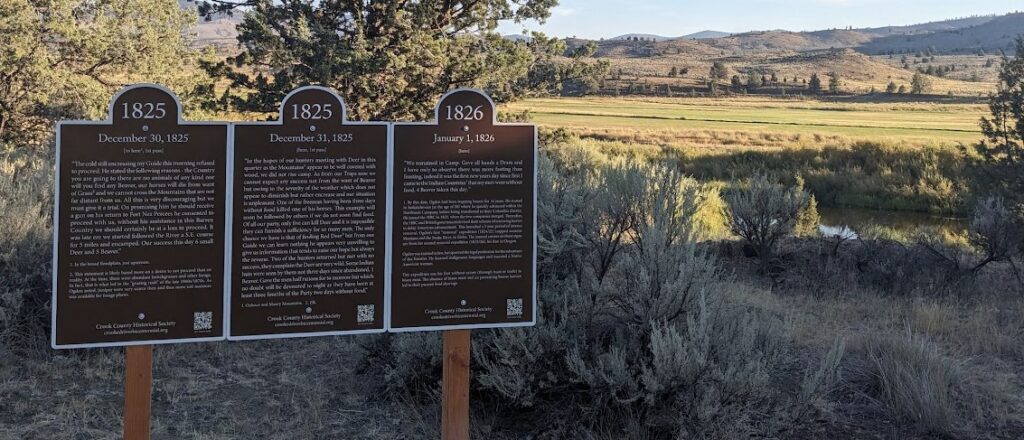
December 30, 1825
to Post
““The cold still encreasing my Guide this morning refused to proceed. He stated the following reasons the Country you are going to there are no animals fo any kind nor will you find any Beaver, our horses will die from want of Grass and we cannot cross the Mountains that are not far distant from us. All this is very discouraging but we must give it a trial. On promising him he should receive a gun on his return to Fort Nez Percees he consented to proceed with us, without his assistance in this Barren Country we should certainly be at a loss to proceed. It was late ere we started followed the River a S.E. course for 5 miles and encamped our success this day 6 small Deer and 5 Beaver.”
December 31, 1825
at Post
“In the hopes of our hunters meeting with Deer in this quarter as the Mountains1 appear to be well covered with wood, we did not rise camp. As from our Traps now we cannot expect any success not from the want of Beaver but owing to the severity of the weather which does not appear to diminish but rather encrease and our situation is unpleasant. One of the freeman having been three days without food killed one of his horses. This example will soon be followed by others if we do not soon find food. Of all our party, only five can kill Deer and it is impossible they can furnish a sufficiency for so many men. The only chance we have is that of finding Red Deer2 but from our Guide we can learn nothing he appears very unwilling to give us information that tends to raise our hope but always the reverse. Two of the hunters returned but met with no success, they complain the Deer are very wild. Some Indian huts were seen by them not three days since abandoned. 1 Beaver. Gave the men half rations for to morrow but which no doubt will be devoured to night as they have been at least three fourths of the Party two days without food.”
1. Ochoco and Maury Mountains. 2. Elk.
January 1, 1826
at Post
“We remained in Camp. Gave all hands a Dram and I have only to observe there was more fasting than feasting, indeed it was the first new years day since first I came to the Indian Countries1 that my men were without food. 4 Beaver taken this day.”
1. By this date, Ogden had been trapping beaver for 16 years. He started in Saskatchewan (at the age of 20) where he quickly advanced within the Northwest Company before being transferred to their Columbia district. He joined the HBC in 1821, when the two companies merged. Thereafter, the HBC and British government devised their scheme of removing beaver to delay American advancement. Ogden was trained in law, but spurned the legal profession for the adventure of the frontier. He learned indigenous languages and married a Native American woman.
This expedition was his first without access (through hunt or trade) to bison meat. The absence of bison meat and ice preventing beaver harvest led, in significant part, to their present food shortage.
December 17–31, 1825 | January 1-13, 1826 | July 3–6, 1826 | Sept 27-Oct 7, 1826